Yuki Goldberg

Artist, Japan日本人。アーティスト。

Universe

We may not be seeing the same universe.

同じ宇宙を見ているとは限らない。

SOLO EXHIBITION / 個展

Universe / 宇宙

December 8–14, 2026
2026年12月8日(火)—14日(月)

Daikanyama Hillside Terrace, Building C
代官山ヒルサイドテラス C棟

Free admission · Weekdays by appointment · No reservation on weekends
入場無料|平日予約制・土日予約不要

Works can also be viewed from outside during the exhibition.
会期中は、会場の外からも作品をご覧いただけます。

LIVE · DEC 12 & 13 · 13:00–20:00
12月12日(土)・13日(日)各日13:00–20:00

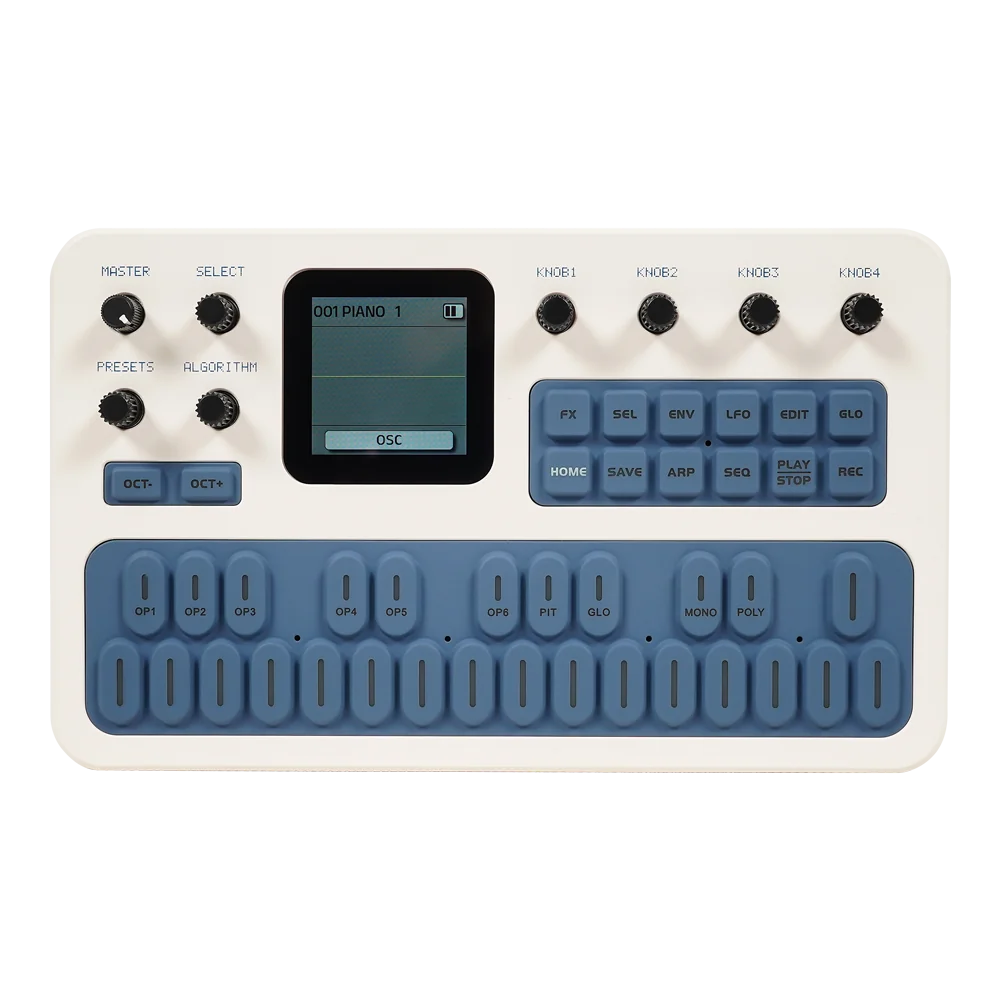
Improvisation by the artist. No PCs. No AI. People and machines.
本人による、宇宙をテーマにした即興演奏。
PCもAIも使わず、人とマシンで音の宇宙を描く。

Exhibition details & reservations 展示詳細・来場予約 →

Selected works作品

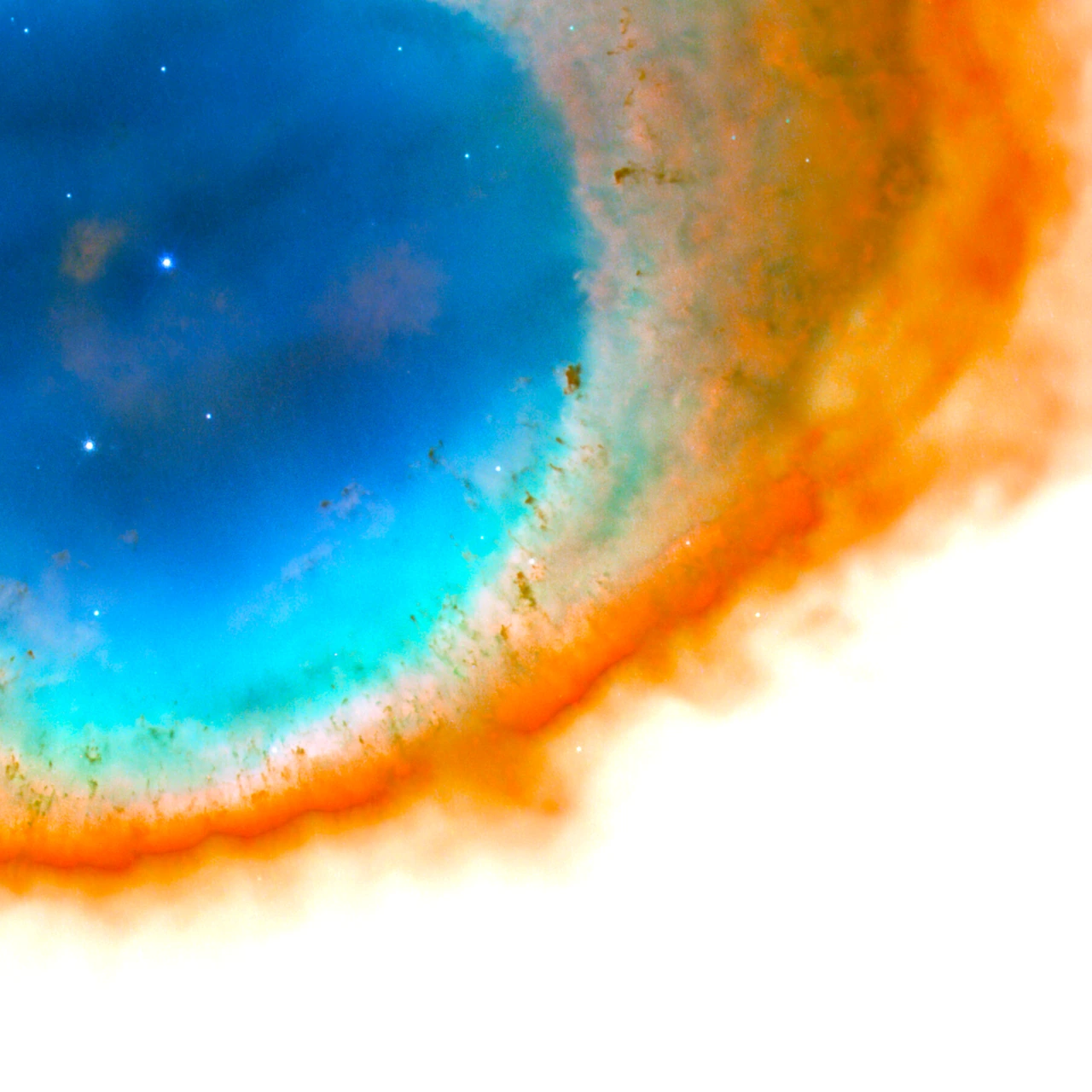
Lenticular workレンチキュラー作品2026
Ring Nebula / リングネビュラ
Drag to explore左右にドラッグして見る

MIRI · Hubble · NIRCam

Ring Nebula

リングネビュラ

74 × 74 cmIncluding white border · W × H白枠込み・幅 × 高さ

Observation観測について

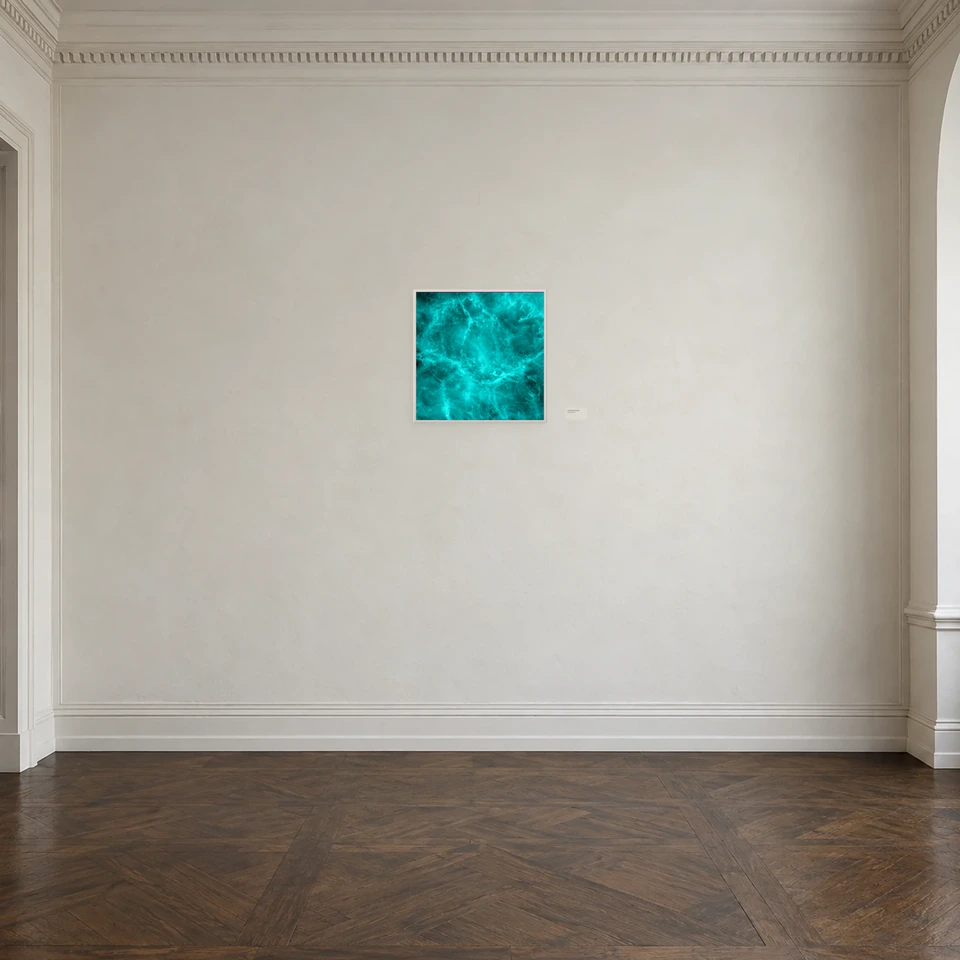
The Ring Nebula (M57) is a planetary nebula about 2,500 light-years away. It consists of gas expelled by its central star late in the star’s life. Webb’s NIRCam shows fine filaments within the ring, while MIRI shows concentric arcs beyond its outer edge.

リングネビュラ(M57)は、約2,500光年先にある惑星状星雲。中心の恒星が寿命の終盤に外層を放出し、そのガスが広がっている。NIRCamでは環の細かなフィラメントが、MIRIでは主環の外側に広がる同心円状の弧がより明瞭に見える。

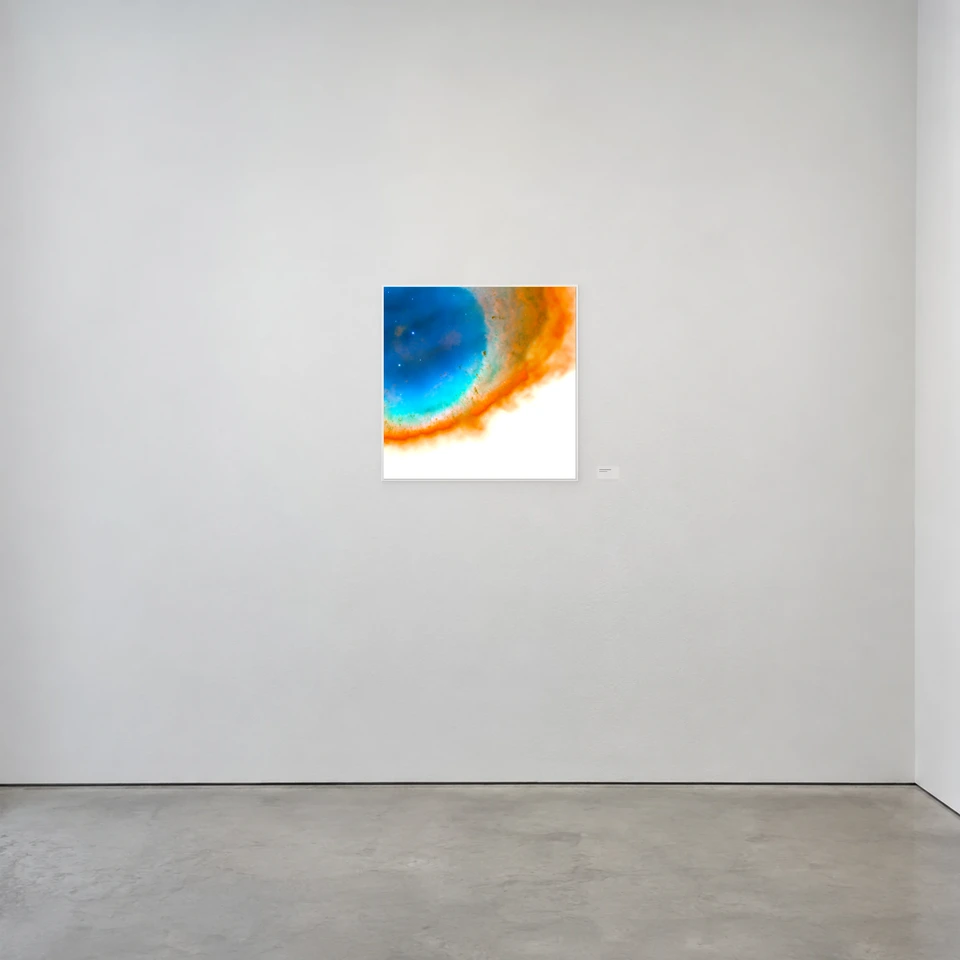
Ring Nebula / リングネビュラ — 白い額でギャラリーに展示したイメージ
Installation view展示イメージ
Drag to explore左右にドラッグして見る

Tarantula

タランチュラ

74 × 59 cmIncluding white border · W × H白枠込み・幅 × 高さ

Observation観測について

The Tarantula Nebula (30 Doradus) is a large star-forming region in the Large Magellanic Cloud. Winds from young, massive stars are clearing the surrounding gas and dust. NIRCam shows the young stars and fine structure of the clouds. In MIRI images, these stars are less prominent, while cooler gas, dust and stars embedded in the clouds become more visible.

タランチュラ星雲(30 Doradus)は、大マゼラン雲にある巨大な星形成領域。若い大質量星からの恒星風が周囲のガスや塵を削っている。NIRCamでは若い星や雲の細かな構造が見える。MIRIではこれらの星が目立たなくなり、より低温のガスや塵、雲に埋もれた星が見えやすくなる。

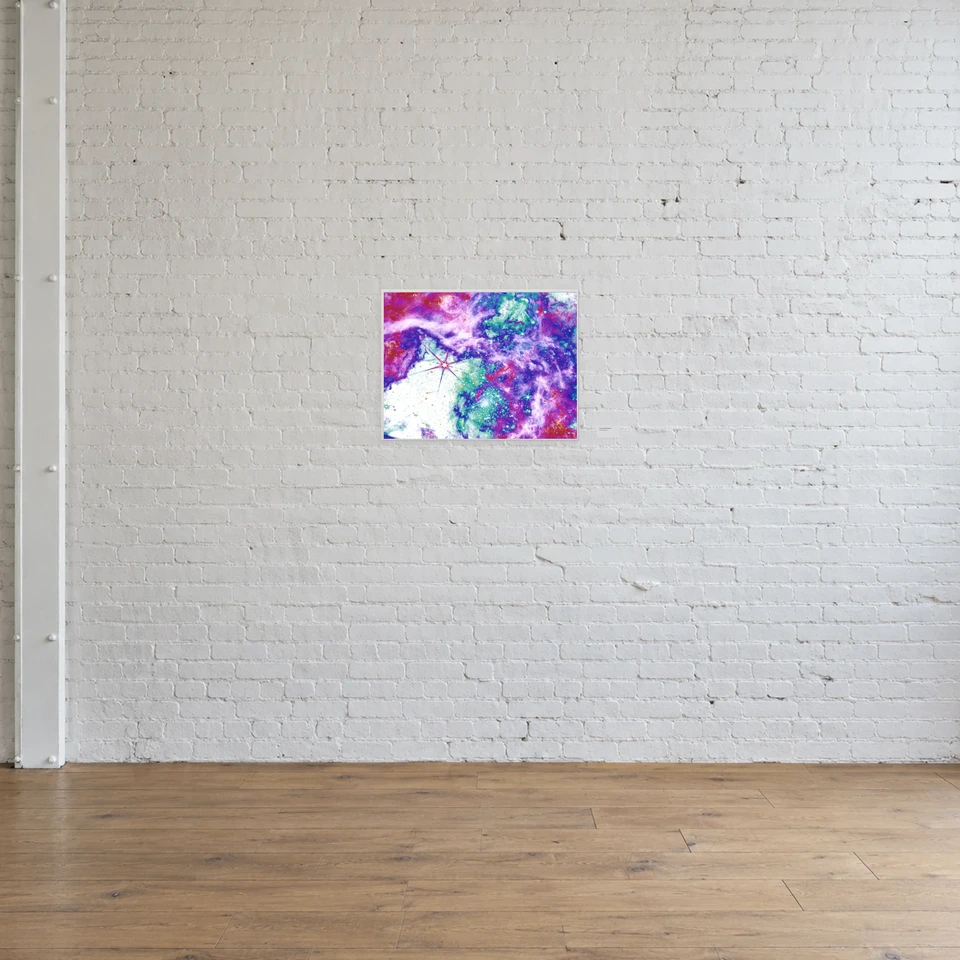
Tarantula / タランチュラ — 白い額でギャラリーに展示したイメージ
Installation view展示イメージ
Drag to explore左右にドラッグして見る

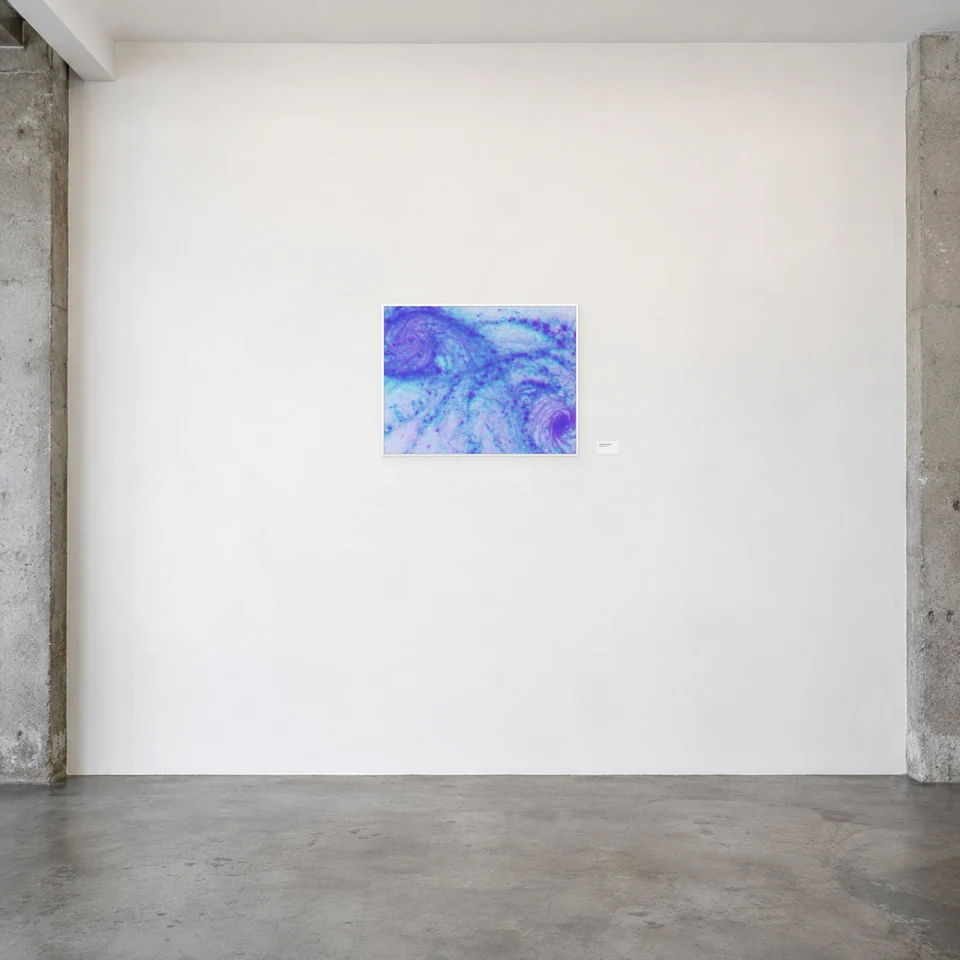
M74

ファントムギャラクシー

40 × 60 cmPrint size · W × H · Frame excluded印刷面・幅 × 高さ・額を含まない

Observation観測について

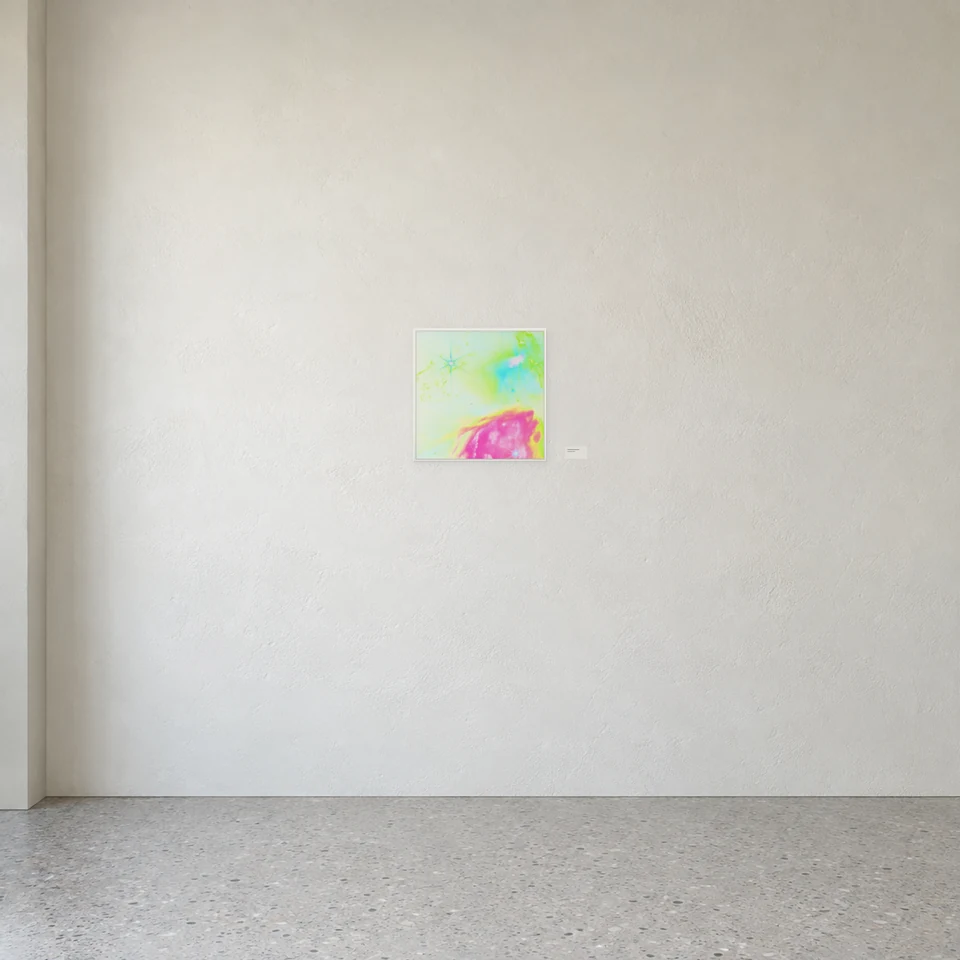
M74 (NGC 628) is a spiral galaxy about 32 million light-years away. Hubble’s visible-light images show stars and star-forming regions along its spiral arms. Webb’s mid-infrared images show the gas and dust distributed through the same arms.

M74(NGC 628)は、約3,200万光年先にある渦巻銀河。ハッブルの可視光像では、渦状腕に沿う星々や星形成領域が見える。ウェッブの中間赤外線像では、同じ渦状腕に分布するガスと塵が見える。

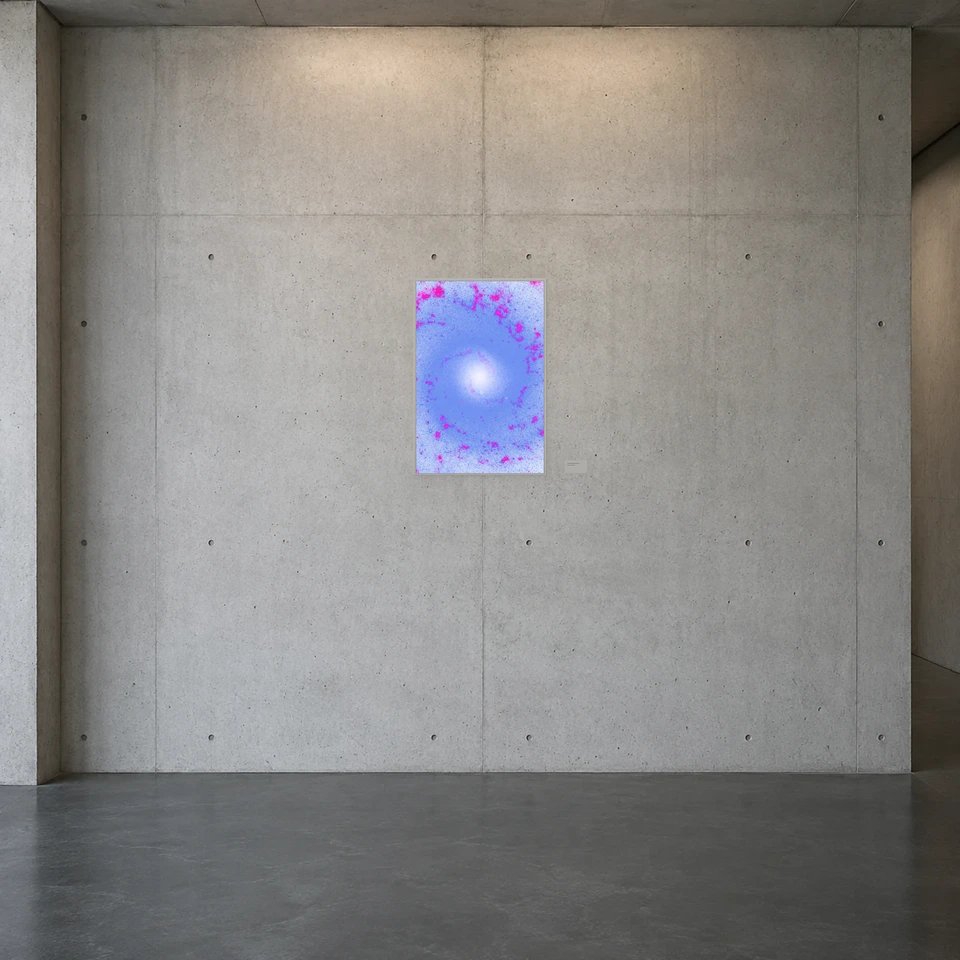
M74 / ファントムギャラクシー — 白い額でギャラリーに展示したイメージ
Installation view展示イメージ
Drag to explore左右にドラッグして見る
NIRCamMIRI

L1527

45 × 60 cmPrint size · W × H · Frame excluded印刷面・幅 × 高さ・額を含まない

Observation観測について

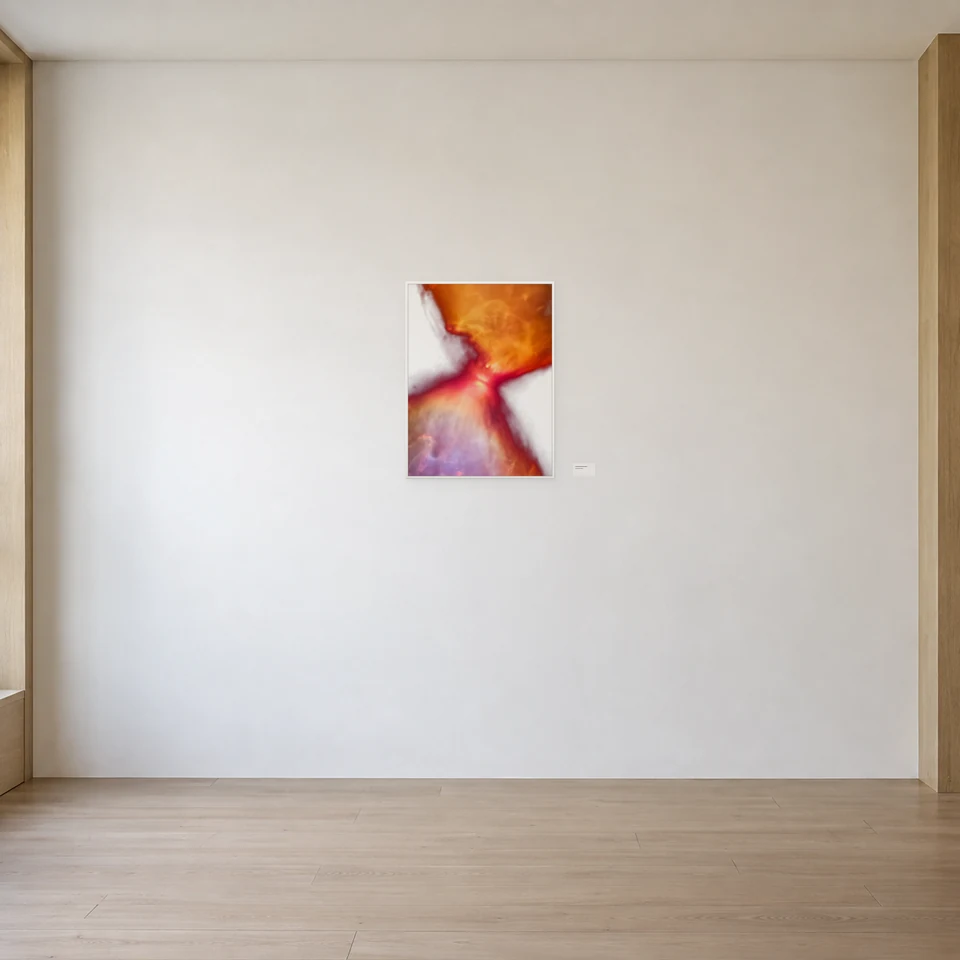
L1527 is a molecular cloud about 460 light-years away containing a forming star. The protostar gathers material from a surrounding disk while ejecting material in opposite directions. These outflows clear cavities in the cloud, producing the hourglass-shaped structure. NIRCam mainly shows starlight reflected by dust around the cavities. MIRI shows emission from gas, dust and carbon-based molecules in the region affected by the outflows.

L1527は、約460光年先にある、形成中の星を含む分子雲。中心の原始星は周囲の円盤から物質を取り込みながら、一部を反対の二方向へ噴き出している。この噴出が雲を押しのけて空洞をつくり、砂時計状の構造ができている。NIRCamでは主に、空洞の周囲の塵が反射する星の光が見える。MIRIでは、噴出の影響を受けた領域にあるガスや塵、炭素を含む分子からの放射が見える。

L1527 / L1527 — 白い額でギャラリーに展示したイメージ
Installation view展示イメージ
Drag to explore左右にドラッグして見る

Webb / MIRI · Mid-infrared / 中間赤外線

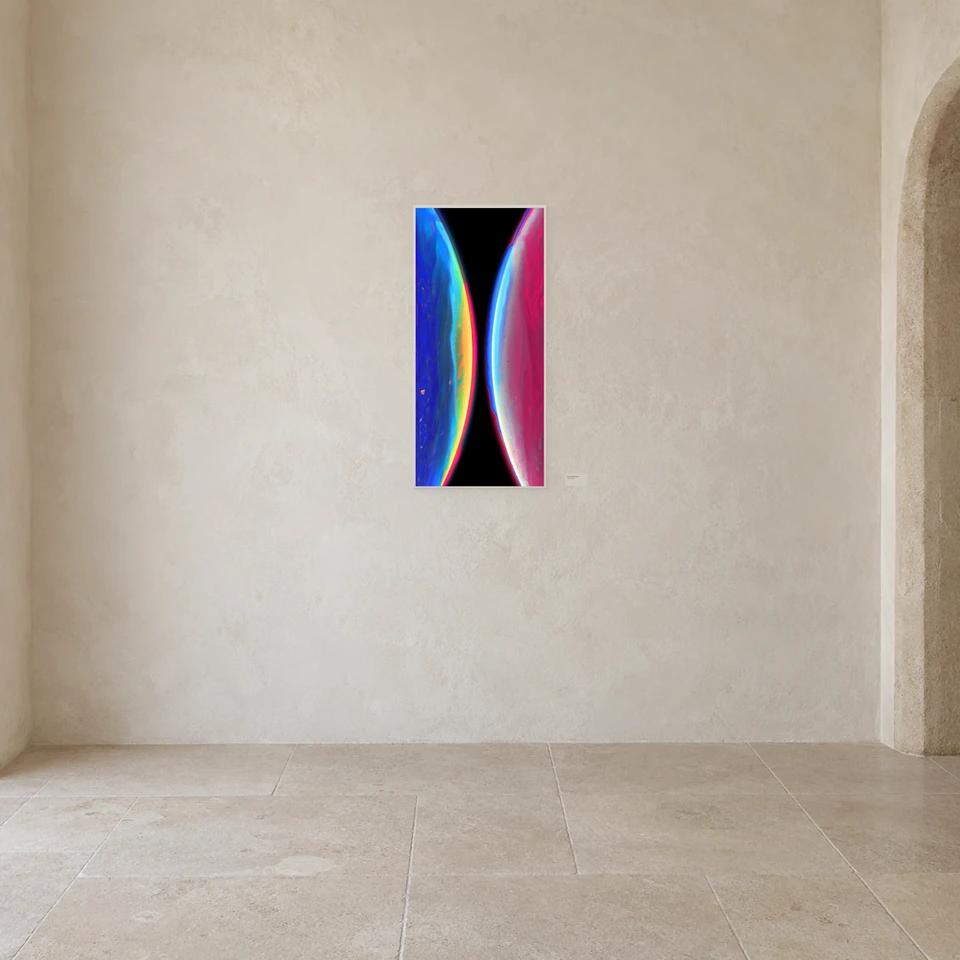
Carina

カリーナ

114 × 59 cmIncluding white border · W × H白枠込み・幅 × 高さ

Observation観測について

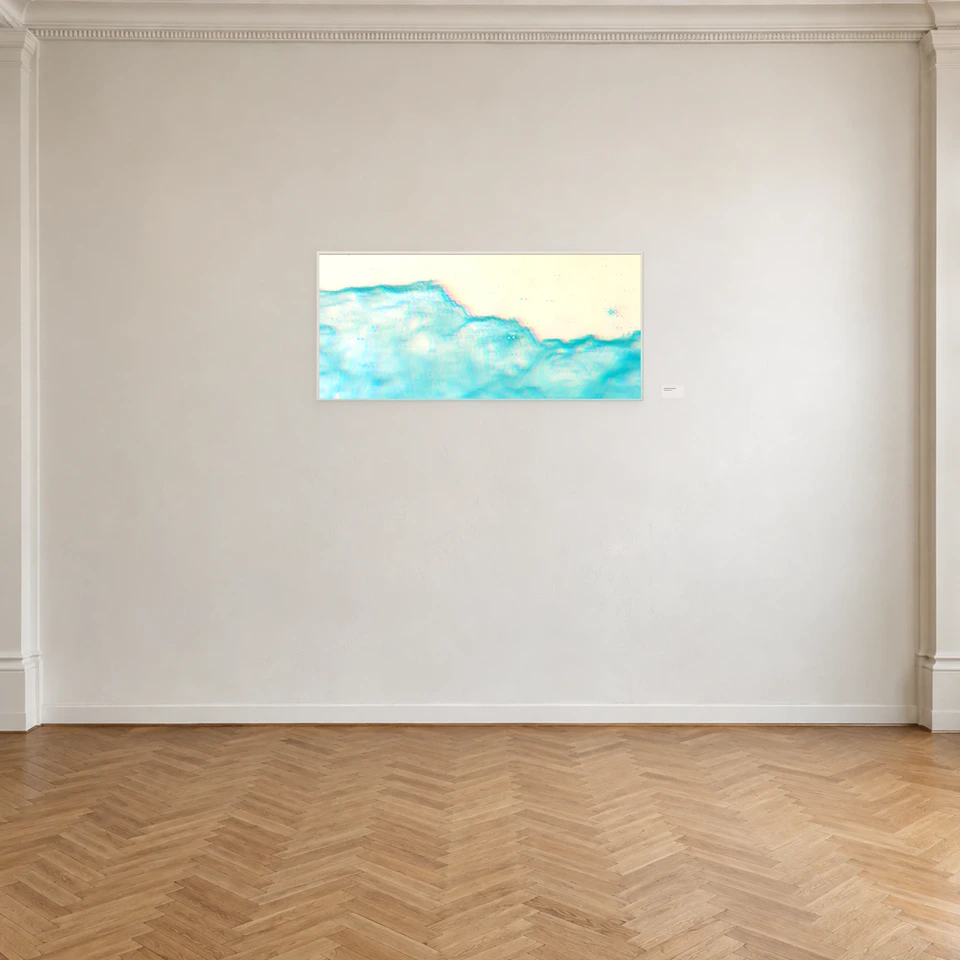
The Cosmic Cliffs are the edge of a large cavity in NGC 3324, a star-forming region in the Carina Nebula complex about 7,600 light-years away. Ultraviolet radiation and stellar winds from young, massive stars outside the field of view are eroding the surrounding gas and dust. This work combines MIRI observations through F770W (7.7 µm), F1280W (12.8 µm) and F1800W (18 µm). All three bands contribute to each view, with 18 µm emphasized on the left, 7.7 µm at the front and 12.8 µm on the right. Visible colors are assigned and adjusted for the artwork.

「Cosmic Cliffs」は、約7,600光年先にあるカリーナ星雲複合体の星形成領域、NGC 3324に開いた巨大な空洞の縁。画面外にある若い大質量星からの紫外線と恒星風が、周囲のガスと塵を削っている。本作は、MIRIのF770W(7.7 µm)、F1280W(12.8 µm)、F1800W(18 µm)の観測像を組み合わせている。すべての視点に3帯域を含み、左では18 µm、正面では7.7 µm、右では12.8 µmを強調している。可視色は作品用に割り当て、調整している。

Carina / カリーナ — 白い額でギャラリーに展示したイメージ
Installation view展示イメージ
Drag to explore左右にドラッグして見る

NIRCam · 2.0 / 3.35 / 4.7 µm

Rho Ophiuchi

へびつかい座ρ

40 × 40 cmPrint size · W × H · Frame excluded印刷面・幅 × 高さ・額を含まない

Observation観測について

Rho Ophiuchi is a star-forming cloud complex about 390 light-years away. Many of the young stars in this field have masses similar to or smaller than the Sun’s. Jets from young stars strike the surrounding gas, causing molecular hydrogen to emit light. The large cavity around the star S1 is being cleared by its stellar winds.

へびつかい座ρ星雲は、約390光年先にある星形成領域。画像内には太陽と同程度か、それより小さな若い星が多数存在する。若い星から噴き出したジェットが周囲のガスに衝突し、分子状水素を発光させている。星S1の周囲にある大きな空洞は、その恒星風によって周囲の物質が削られてできている。

Rho Ophiuchi / へびつかい座ρ — 白い額でギャラリーに展示したイメージ
Installation view展示イメージ
Drag to explore左右にドラッグして見る

Crab Nebula

かに星雲

54 × 54 cmIncluding white border · W × H白枠込み・幅 × 高さ

Observation観測について

The Crab Nebula is the remnant of a supernova observed from Earth in 1054. At its center is a pulsar, a rapidly rotating neutron star. Hubble shows filaments of gas expelled in the explosion. Webb’s infrared images also show dust and synchrotron radiation—light emitted by charged particles accelerated by the pulsar as they move through magnetic fields. The right view uses Hubble’s F502N filter, which primarily records [O III] emission near 500.7 nm from doubly ionized oxygen, along with some continuum light. Brightness also depends on temperature, density and ionization, not only oxygen abundance.

かに星雲は、1054年に地球から観測された超新星爆発の残骸。中心には高速で自転する中性子星「パルサー」がある。ハッブルでは爆発で放出されたガスのフィラメントが見える。ウェッブの赤外線像では、塵やシンクロトロン放射も見える。シンクロトロン放射は、パルサーによって加速された荷電粒子が磁場の中を動くことで生じる。右の像はハッブルのF502Nフィルターで、主に電子を2個失った酸素イオン [O III] が放つ約500.7nmの光を捉えたもの。連続光も含まれ、明るさは酸素の量だけでなく温度・密度・電離状態にも左右される。

Crab Nebula / かに星雲 — 白い額でギャラリーに展示したイメージ
Installation view展示イメージ
Drag to explore左右にドラッグして見る
Hubble · UV / Visibleハッブル・紫外線/可視光Webb · Mid-infraredウェッブ・中間赤外線

IC 2163 / NGC 2207

IC 2163/NGC 2207

60 × 46.14 cmPrint size · W × H · Frame excluded印刷面・幅 × 高さ・額を含まない

Observation観測について

IC 2163 and NGC 2207 are interacting spiral galaxies. They passed close to one another millions of years ago, and their mutual gravity has distorted their shapes. Both contain active star-forming regions. Hubble’s ultraviolet and visible-light images emphasize stars, while Webb’s mid-infrared images show dust along the spiral arms.

IC 2163とNGC 2207は、相互作用している2つの渦巻銀河。数百万年前に接近し、互いの重力によって形が変わっている。両銀河では活発な星形成が続いている。ハッブルの紫外線・可視光像では星が、ウェッブの中間赤外線像では渦状腕に沿う塵が目立つ。

IC 2163 / NGC 2207 / IC 2163/NGC 2207 — 白い額でギャラリーに展示したイメージ
Installation view展示イメージ
Drag to explore左右にドラッグして見る

Gemini North / NIRI · Webb / NIRCam

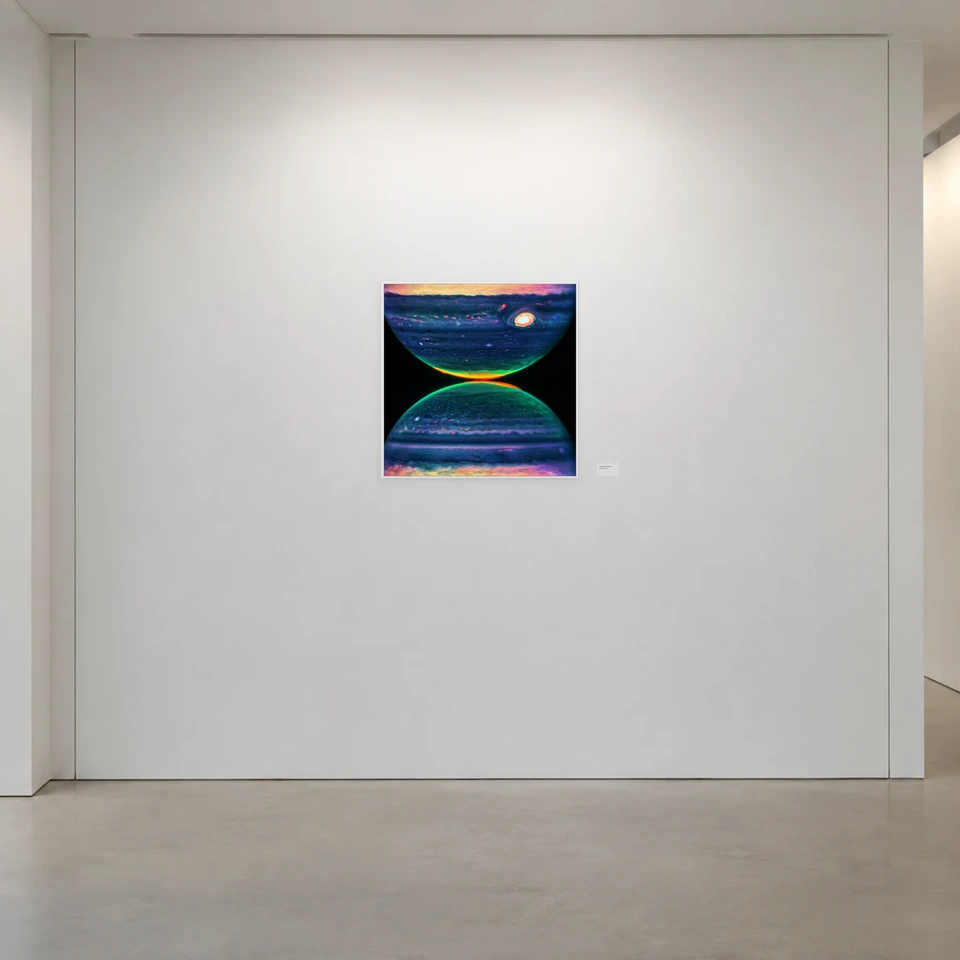
Jupiter

木星

60 × 60 cmPrint size · W × H · Frame excluded印刷面・幅 × 高さ・額を含まない

Observation観測について

This work brings together a 4.68 µm view of Jupiter recorded by Gemini North’s NIRI on 11 January 2017 and near-infrared views recorded by Webb’s NIRCam on 27 July 2022. In the Gemini image, thermal emission appears bright while the cloud-covered Great Red Spot is dark. The Webb images show sunlight reflected by clouds and high-altitude hazes, together with auroral emission near the poles. The front view uses the F150W2, F212N and F360M composite; the right view uses the F212N and F335M composite.

この作品は、Gemini NorthのNIRIによる2017年1月11日の4.68 µm像と、ウェッブのNIRCamによる2022年7月27日の近赤外線像を組み合わせている。Gemini像では熱放射が明るく見え、雲に覆われた大赤斑は暗く映る。ウェッブ像では、雲や高高度の霞が反射する太陽光と、極域のオーロラの放射が見える。正面にはF150W2・F212N・F360Mの3帯域合成像、右にはF212N・F335Mの2帯域合成像を用いている。

Jupiter / 木星 — 白い額でギャラリーに展示したイメージ
Installation view展示イメージ
Drag to explore左右にドラッグして見る

NIRCam · Near-infrared / 近赤外線

2-band / 2帯域:2.12 / 3.35 µm

3-band / 3帯域:1.5 / 2.12 / 3.6 µm

Jupiter 2

木星 2

40 × 86.91 cmPrint size · W × H · Frame excluded印刷面・幅 × 高さ・額を含まない

Observation観測について

Jupiter’s auroras form when charged particles guided by its magnetic field collide with gases in the upper atmosphere. This work uses two Webb NIRCam composites recorded on 27 July 2022: F150W2, F212N and F360M (approximately 1.5, 2.12 and 3.6 µm), and F212N and F335M (2.12 and 3.35 µm). Cropped portions of these observations are arranged in three viewing states, with color adjusted for the artwork.

木星のオーロラは、磁場に導かれた荷電粒子が上層大気のガスと衝突することで生じる。本作は、ウェッブのNIRCamが2022年7月27日に記録したF150W2・F212N・F360M(約1.5・2.12・3.6 µm)の3帯域合成像と、F212N・F335M(2.12・3.35 µm)の2帯域合成像を素材としている。観測像の一部を切り出して3つの視点に構成し、作品用に色を調整している。

Jupiter 2 / 木星 2 — 白い額でギャラリーに展示したイメージ
Installation view展示イメージ

About the colors色について

The source images include observations at wavelengths invisible to the human eye. Visible colors are assigned to data recorded through different filters.

Yuki Goldberg uses astronomical observation images as source material, editing their colors, tonal range, composition and the combinations of observations.

素材となる画像には、人間の目には見えない波長の観測も含まれる。異なるフィルターで得られたデータに可視色を割り当てている。

Yuki Goldbergは実際の宇宙観測画像を素材とし、色、階調、構図、観測像の組み合わせを編集している。

Contactお問い合わせ

For enquiries about works or projects, please get in touch.作品や活動についてのお問い合わせは、メールでご連絡ください。

yukillbient@gmail.comInstagram @yuki.goldberg ↗

Each lenticular work is one of a kind. Print dimensions are listed with each work. Framing and delivery will be confirmed individually before an order.レンチキュラー作品はすべて一点物です。印刷面の寸法は各作品に記載しています。額装・納期は、ご注文前に個別にご案内します。

Ask

/

Yuki Goldbergの作品と活動をご案内します。何を知りたいですか?

会話は記録され、作家・運営者が確認します。